News & Events
Rwanda's Key Agriculture Stakeholders Launched Sustainable Agricultural Mechanization Program to Empower Smallholder Producers
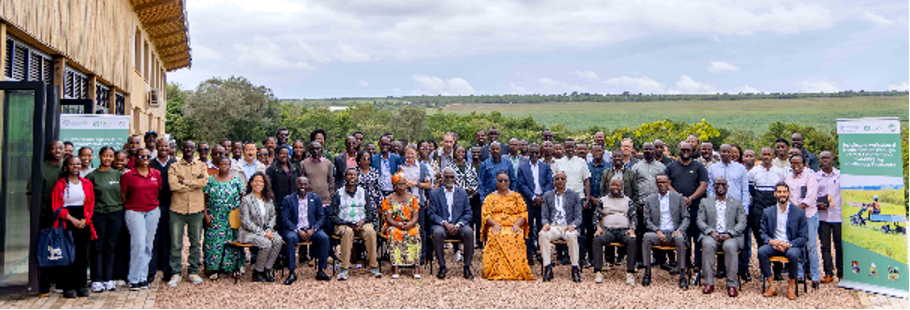
The Food and Agriculture Organization of the United Nations (FAO) in Rwanda, the Rwanda Institute for Conservation Agriculture (RICA), and the Rwanda Agriculture and Animal Resources Development Board (RAB) officially launched the Sustainable Agricultural Mechanization through Farmer Field Schools (SAM-FFS) for Smallholder Producers project at the RICA campus in Bugesera. This joint initiative is designed to equip smallholder farmers with essential skills in climate-smart, appropriately scaled, business-oriented mechanization and conservation agriculture practices.
The Sustainable Agriculture Mechanization through Farmer Field School (SAM/FFS) initiatives represent a milestone partnership between three leading institutions at the forefront of Rwanda’s agricultural transformation. Through this joint effort between FAO, RICA, and RAB, the initiative is strengthening capacity across the agricultural mechanization ecosystem, including local producers, farmer facilitators, cooperatives, and repair service providers, to adopt and integrate environmentally, economically, and socially responsible mechanization practices that enhance productivity while preserving natural resources.
Dr. Nomanthema Mhalanga, FAO Rwanda Representative (a.i.), underscored the collective commitment to sustainable agricultural transformation, advancing support for smallholder farmers through Farmer Field Schools.
This intensive program utilized the participatory Farmer Field School (FFS) model to foster experiential learning. During the initial part of the training, FFS facilitators acquired practical skills in sustainable agricultural mechanization (SAM) and conservation agriculture (CA), including basic machinery operation and effective farmer-centered learning techniques. They were also guided on how to integrate these technical areas into locally adapted FFS curricula using core FFS principles and processes. Read More
Related information is also available on Read More