News & Events
Retiring the Hand Hoe and the Call to Action to Member States, Private Sector and Development Partners
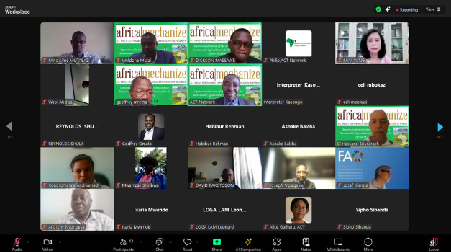
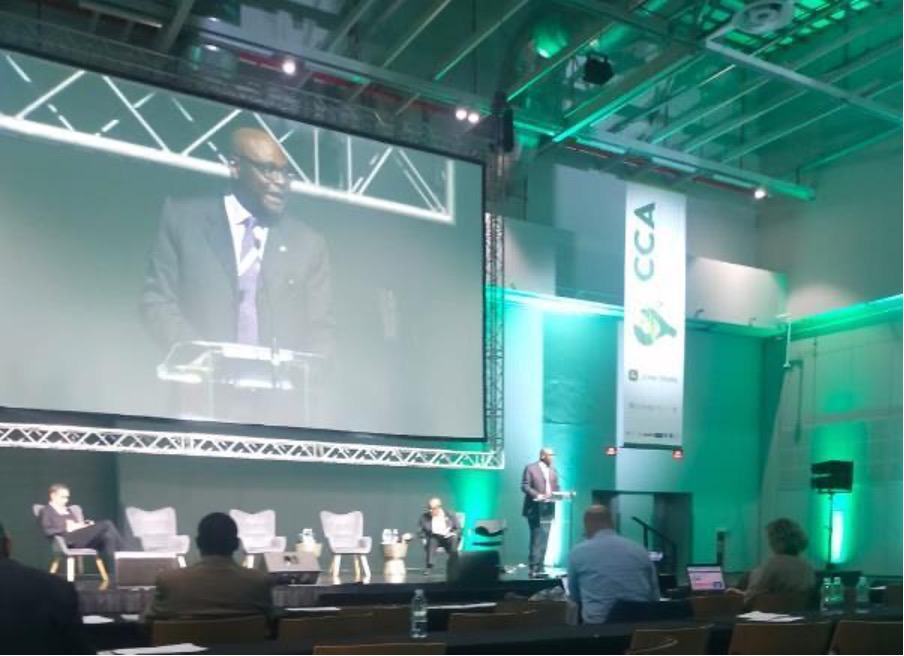
Prof. Jerome Afrikheina, Special Adviser to the Commissioner for Rural Economy and Agriculture, African Union Commission, Addis Ababa, Ethiopia joined the discussion during webinar organized and held on 23rd July, 2024 as a special plenary session at the Ninth World Congress on CA (9WCCA). He invariably highlighting with the exception of South Africa and some countries in North Africa, the situation Africa’s Agriculture which is dominated by peasant small holder farmers usually cultivating 1- 2 acres, largely rain fed and low input farming systems with predominant use of manually based rudimentary production tools particularly the hoe and rely on continuous tillage-based systems. This has to the larger extend contributed to the low productivity of Africa’s agriculture. This means that Africa has to rely on a lot of food importations in order to feed itself.
Besides, Africa is the continent with the least mechanized agricultural system in the world. FAO estimated that 65% of the farm power is still provided by human muscles and the rest by draught animal. It is only 10% of total power for land preparation in sub-Saharan Africa comes from engine-powered machines, usually using fossil fuels. Therefore, the transformation of agricultural systems is necessary not only to increase production but also enabling sustainable and equitable food systems that generate well for small producers and agricultural practitioners along the value chain including workers, women and youth. There is also need to prioritize access to nutritious food, environmental sustainability and resilience. This is where Conservation Agriculture (CA) and sustainable agriculture mechanization (SAM) comes in since they have critical role in catalysing the transformation of Africa’s agriculture to be more productive, resilient and sustainable to be able to meet the ever-growing demand. In addition, Prof. Jerome expressed that he attended the Third Africa Congress on conservation agriculture (3ACCA) held in Rabat, Morocco on 5th – 8th June 2023 where African’s position and agenda on CA was set indicating that a lot has so far been achieved but there is still a long way to go.
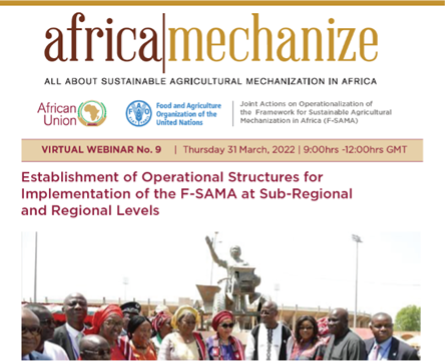
According to Prof. Jerome, women are the backbone of Africa’s agriculture across the value chains especially rural production and marketing. In Some African Countries, they account for up to 50% of the labour force in family farming. Unfortunately, why women account for this large proportion to feed the continent, they have remained largely in the background receiving very little assistance. As part of the efforts towards mechanizing Africa, with the request from African Ministers, AUC with partnership with FAO develop Framework for Sustainable Agricultural Mechanization in Africa (F-SAMA) which was launched in 2018 by AU and FAO and provides guidance on how to assist the development of sustainable mechanization in the agri-food systems in the continent.
In concluding, Prof. Jerome emphasise that the Africa Union need to be fully engaged to mainstream conservation agriculture not just in sending the hoe to museum mechanization program, but in other initiatives such as the Africa Fertiliser and Soil Health plan adopted after Africa Fertiliser and Soil Health summit held in Nairobi, Kenya as well as on-going Post- Malabo process to unveil the ten-year Agricultural plan for Africa. Lastly, Prof. Jerome to express their sincere gratitude to organizers of this webinar and the 9WCCA. This has enabled us share best practices, and collectively chart a course towards acceleration adoption of CA through appropriate sustainable mechanization. The decisions and commitments made during this discussion will undulate beyond our gathering and have a profound impact on the livelihoods of millions of Africans. Let us seize this opportunity to forge partnerships, leverage innovative approaches, and advance the shared vision of mechanized conservation agriculture that will propel Africa towards a future of prosperity and abundance for all.